The mortgage payment cleared on the first, like always. Then came the electric bill, the water bill, and the lawn service. You looked at the stack and realized something. You are paying all of this for a house nobody lives in.
Your home in Bridgewater has been empty since you moved out in August. It has been on the market for seven weeks. You want to sell it, but you also do not want to pour more money into it. So when your agent brings up staging, your first thought is simple. “I can’t afford that right now.”
That is a fair thing to feel. But it may be the wrong question. On a tight budget, the real question is what the empty house is already costing you each month, and how long you can keep paying it.
The bill nobody puts in the budget
Most sellers plan for the big costs, like agent fees and closing costs. Very few plan for carrying costs. Carrying costs are the bills you keep paying on a home while it sits on the market.
For a vacant home, that list adds up fast. There is the mortgage, property taxes, and insurance. There is power to keep the air running, so the house does not get musty in the Florida heat. There is lawn care, pest control, and pool service if you have one. None of these stop just because you moved out.
Let’s say all of that comes to $3,000 a month on your Bridgewater home. Every extra month on the market is another $3,000 gone. You get nothing back for it, not even a nicer house. That is the number Whitney Lohr asks sellers to write down before they decide anything about staging.
What the Wesley Chapel numbers are telling sellers
Whitney has worked with homes in Wesley Chapel and New Tampa for about 20 years. She has seen fast markets and slow ones. Right now, the Tampa area is a buyer’s market. That simply means there are more homes for sale than buyers ready to buy them, so buyers can take their time and be picky.
You can see it in how long homes are sitting. In Wesley Chapel, homes sold after about 68 days on the market, up from 53 days a year earlier, according to Redfin’s Wesley Chapel housing market report. That is about two extra weeks of carrying costs for the typical seller.
The same report shows that 48.2 percent of Wesley Chapel homes for sale had a price drop in September. A price drop is when the seller lowers the asking price after the home is already listed. Nearly half the sellers in town have already taken one.
A price cut is a cost too
When a home sits, the usual fix is to lower the price. It feels like the free option, because you do not write a check. But it is not free at all.
A $10,000 price cut on your Bridgewater home is $10,000 less at closing. A second cut a month later is more. And while you wait to see if the cut works, the carrying costs keep running in the background.
Now put staging next to that. In the National Association of Realtors 2025 home staging report summary, the median cost of a staging service was $1,500. Median just means the middle number, so half of jobs cost more and half cost less. That figure covers all kinds of homes and jobs across the country, so fully staging a vacant home will often cost more.
Even so, the same NAR summary found that 49 percent of sellers’ agents said staging cut the time a home spent on the market. And 29 percent said staged homes drew offers that were 1 to 10 percent higher. Staging is not a promise. But it is one fixed cost aimed at the two things eating your budget: time and price.
Rule one: spend where buyers look first
If money is tight, Whitney’s first rule is to put it where buyers will see it. And buyers see your home on a phone long before they ever see it in person.
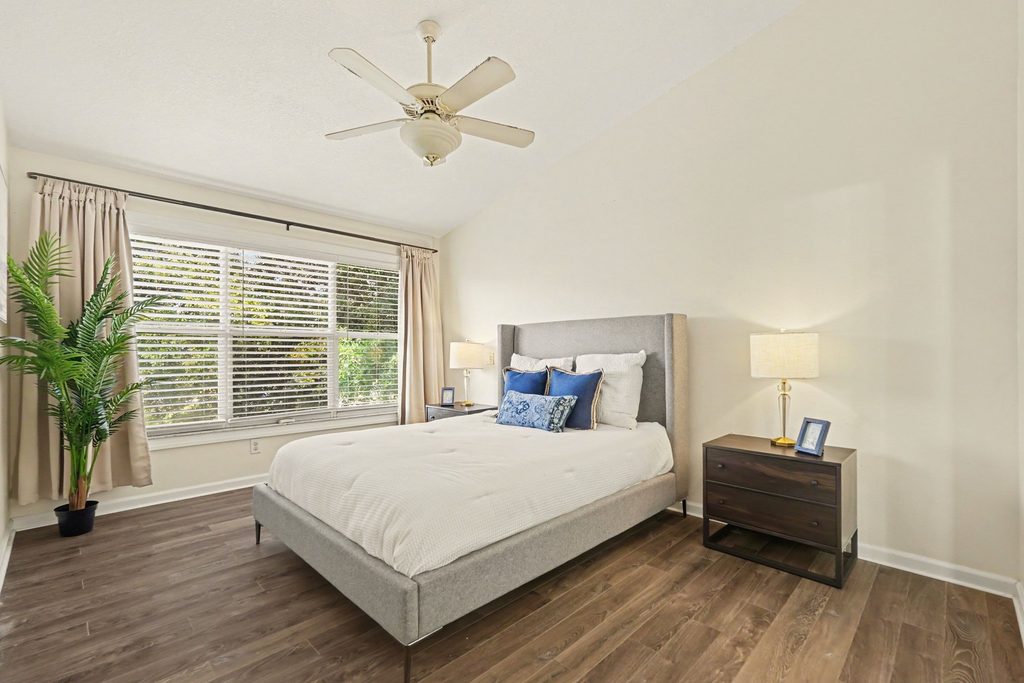
In that NAR report, 73 percent of buyers’ agents said listing photos were highly important to their clients. An empty room in a photo is just carpet and four walls. Buyers scroll right past it. A furnished living room gives them a reason to stop and book a showing.
So the staging should be in place before the photographer shows up. If your home is already listed with empty photos, get new ones taken the day after the furniture arrives. That small step costs little and gives your listing a fresh first impression.
Rule two: know exactly what you are paying for
A budget works best when there are no surprises. Before you hire any stager, ask a few plain questions.
Which rooms are included? How long does the furniture stay? What happens if the home takes longer to sell than planned? Is there a monthly fee after the first period? These answers tell you your real cost, not just the starting price.
This is where staging is different from carrying costs. Carrying costs have no end date. A staging agreement has clear terms you can plan around. On a tight budget, a cost you can see is far easier to manage than one that keeps growing.
Rule three: do the free work first
Some of the best prep costs almost nothing. In the NAR Profile of Home Staging, agents’ top advice to sellers included cleaning the whole home and improving curb appeal. Curb appeal is how the home looks from the street.
For a vacant home, that means a deep clean, fresh bulbs, and a tidy yard. Pick up the flyers on the porch and pull the weeds by the front walk. An empty house that looks cared for gets better offers than one that looks forgotten.
Do all of this before the staging goes in. That way every dollar you spend on furniture is working in a clean, bright space.
What about staging with your own furniture?
You may hear about occupied staging. That is when a stager works with the furniture already in the home while the seller still lives there. It can cost less, and it makes sense for sellers who are not ready to move out yet.
Tailored Spaces does not offer occupied staging. The company only does full staging of vacant homes, because that is where staging makes the biggest difference. An empty house has the most to gain, and staging every main room at once keeps the look steady from the front door to the back patio. You can see finished homes in the Tailored Spaces staging portfolio.
Do the math before you decide
Here is the simple version. Add up what your empty home costs you each month. Then ask what one more month on the market, or one more price cut, would take out of your pocket. Put a staging quote next to those numbers and see which one looks bigger.
For a lot of sellers, staging stops looking like an extra expense. It starts looking like the cheapest way to stop the other bills.
Let’s look at your numbers together
If your vacant home in Bridgewater, or anywhere in Wesley Chapel, has been sitting longer than you planned, Whitney can help you sort it out. She will walk the home with you, look at what it costs you to wait, and tell you plainly whether staging makes sense for your sale.
Contact Whitney Lohr at Tailored Spaces by calling 813-394-0759, emailing whitlohr@gmail.com, or visiting tailoredspacestampa.com to set up a time.